
Dental Implant SEO: Proven Strategies to Boost Rankings


Dental Implant SEO: Proven Strategies to Boost Rankings
Quick Answer: Dental Implant SEO succeeds when you pair highly targeted keywords for Implant procedures with surgical on-page structure, strict technical thresholds (LCP <2.5s, mobile-first), and a local-first backlink strategy that drives qualified leads. Follow one repeatable 7-step process and you’ll cut wasted spend and increase visibility for purchase-intent queries.
Why competition for Dental implants demands a solid SEO foundation
Implant services attract motivated patients who Search with commercial intent — they want pricing, financing options, and before/after evidence. That intent makes Rankings worth measurable revenue. Organic Search still feeds the top of the funnel for high-ticket procedures like implants, and the set of providers is growing in every metro. If your site isn’t structured to capture purchase intent, paid ads will eat your budget.
Key result: a Search-optimized Implant offering turns visibility into predictable, qualified leads.
How do we choose the right keywords for Implant services?
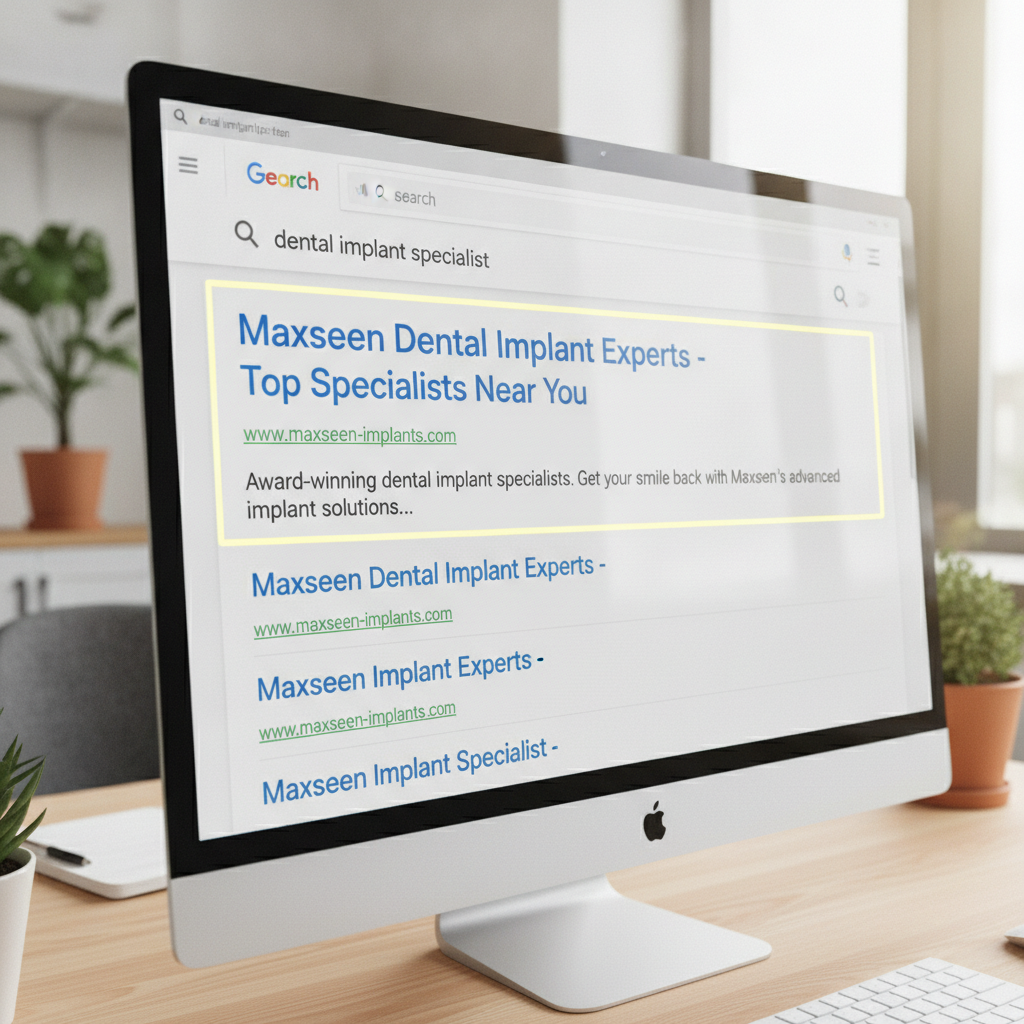
Start with a small, high-intent seed list, expand with tools, then filter. Do that in order and document everything in a spreadsheet.
We recommend this exact process — implement the steps below and assign owners and dates.
- Seed list (day 0): compile 8–12 phrases you already rank for or want to own. Examples: “Dental implants [city]”, “full mouth implants”, “Implant dentist near me”.
- Expand (day 1): use Keyword Planner, Ahrefs, or SEMrush to expand each seed to 50 related terms. Keep phrase match and question formats (“how much do Dental implants cost”).
- Filter by intent and thresholds (day 1–2): remove informational-only queries unless you have a content funnel. Keep queries that meet at least one of these: monthly volume >60, commercial modifier present (cost, price, financing, consultation), or local modifier (city, near me). Mark each with volume and KD/DR.
- Accept if monthly volume >60 and keyword difficulty <45 (tool-specific).
- Accept local modifiers regardless of volume if they match priority service areas.
- Reject broad terms like “implants” without context — they attract low-conversion traffic.
- Map pages (day 3): assign 1 primary keyword to each service or location page, and 2–3 secondary variations for longform content and FAQs. Never target multiple primary keywords with the same page.
- Monitoring (ongoing): track the top 30 priority keywords daily for 90 days, weekly after that. If a keyword shows no positive movement in 60 days, run a content and on-page audit for that landing page.
One screening rule we follow: favor commercial intent queries with local modifiers — they convert best for Implant services.
Dental Implant SEO: on-page optimization that actually converts
Structure pages for both Search engines and the patient decision process — clarity at the top, proof and options in the middle, a friction-free conversion zone at the end.
Start with page templates. Here’s a practical template you can copy for every Implant service page.
- Title tag pattern (50–60 chars): [Primary Keyword] — [City] | [Clinic Name]
- Meta description (120–155 chars): Benefit + offer + CTA. Include primary keyword once.
- H1: exact primary keyword once (keep it natural).
- Top section (50–120 words): quick value proposition, mention options (single, all-on-4), and a CTA button with phone and form.
- Content blocks: Procedure overview, candidacy, financing, timeline, before/after gallery, patient testimonials, FAQ (schema), and a final CTA.
Technical specifics for on-page markup:
- Use structured data: Service schema and FAQ schema. Include organization schema for the practice. Link to authoritative pages about implants where relevant (American Dental Association – Dental Implants Overview).
- Title tags: keep them unique and keep the primary query left-aligned.
- Meta descriptions: write for clicks — include a local signal (city) and a differentiator (e.g., “0% financing”).
- Images: use descriptive filenames and alt text tied to the page keyword; defer large images and use WebP.
One on-page rule we enforce: every Implant service page must contain an FAQ block of at least five questions answered in 40–80 words each and marked up with FAQ schema.
Exact content-length and structure guidance
Answer-first paragraph: 50–120 words. Procedure sections: 300–700 words depending on complexity. Location pages: 400–800 words. Longform pillar page for implants: 1,200–2,000 words that targets broad commercial topics and links to each service page.
Which technical SEO thresholds matter most for Implant pages?
Prioritize Core Web Vitals, secure hosting, and crawl accessibility — these are non-negotiable performance gates.
Apply these exact thresholds during the technical audit.
- LCP (Largest Contentful Paint): target <2.5 seconds. If LCP >3.0s, prioritize image optimization and critical CSS.
- CLS (Cumulative Layout Shift): aim <0.1. Pinpoint layout shifts caused by late-loaded ads, fonts, or iframes.
- FID/INP: aim for FID <100ms or INP equivalent under 200ms for interaction readiness.
- Mobile: pass Google’s mobile usability with zero errors; viewport configured; font sizes readable; tap targets >48px.
- HTTPS: force HSTS and redirect all HTTP to HTTPS. No mixed content.
- Sitemap and robots.txt: include only indexable URLs and submit sitemap to Google Search Console. Ensure sitemap updates within 24 hours of major content changes.
- Canonical tags: canonicalize printer/faceted or sessioned URLs. No multiple canonicals pointing to different pages.
If your LCP is above 3s or your mobile passing rate is below 95%, treat those as blockers to rank improvement.
How should you build backlinks for Dental Implant Search visibility?
Focus on relevance, local authority, and referral pathways that bring real prospects — not link volume. A handful of well-placed links beats a pile of low-quality listings every time.
Backlink tactics ranked by ROI (highest to lowest):
- Local clinical citations and partnerships: partner with local oral surgeons, labs, or Dental schools and secure resource pages linking to your Implant pages.
- Patient education content on local sites: publish a longform patient guide on your site and syndicate condensed versions to local health portals with a contextual link back.
- Press & PR: a single local press piece about case results or community involvement can drive both links and trust.
- Guest posts: limited use — prioritize quality over quantity; aim for sites with topical relevance (Dental/health) and domain authority >30.
- Directories: use high-quality, niche Dental directories and local business directories; avoid bulk low-quality submissions.
Outreach script essentials (use exactly this structure):
- Subject: “Local resource for Dental implants — short request”
- First line: compliment a specific resource on their site.
- Second line: offer a short, unique resource (350–700 words) or a patient guide tailored to their audience.
- Close: request a contextual link to “[Clinic Name] Implant guide” and offer to promote the piece on your channels.
Backlinks that drive patients come from local relevance and consumer-facing resources, not raw domain authority alone.
What conversion steps turn Implant traffic into booked consultations?
Make conversion frictionless and measure every touchpoint — call tracking, form tracking, and appointment submissions are critical.
Conversion checklist with exact settings:
- Primary CTAs: phone click-to-call, and a short contact form with 5 fields max (name, phone, email, brief concern, preferred contact time).
- Phone tracking: use a dynamic number insertion (DNI) solution and route calls into your CRM. Set call conversion threshold at calls >60 seconds to qualify as lead.
- Forms: require double opt-in for email but keep phone as the main lead contact. Track form submissions via GA4 event with category “lead” and action “implant_form”.
- Landing pages: run single-variant A/B tests for headline and CTA placement for at least 3,000 visitors or 90 days, whichever comes first.
Measure leads by qualified phone calls plus booked consultations, not raw form submissions.
Exact 7-step implementation process (copyable checklist)
Follow these steps in order and assign owners and deadlines; this is the tactical playbook we use for Implant clients.
- Audit (days 1–7): run a keyword map, site crawl (Screaming Frog), and Core Web Vitals report. Score each area 0–5 for priority.
- Technical fixes (days 8–21): resolve any red-score items from audit; hit LCP <2.5s, mobile usability 100% pass, and publish sitemap updates.
- On-page rollout (days 15–45): implement new title/meta templates, H1/H2 structure, and FAQ schema on priority pages.
- Local signals (days 20–60): update Google Business Profile, fix NAP citations, and solicit 5–10 recent reviews with responses weekly.
- Content expansion (days 30–75): publish one pillar Implant guide and 3 supporting posts targeting long queries and FAQs.
- Backlink outreach (days 45–90): complete 30 outreach touches for local partners and resource pages; aim for 5–12 placements in 90 days.
- Measurement & iteration (days 60–90): evaluate priority keyword movement, lead volume, and on-page conversion rate. If a KPI misses target by >20%, reallocate resources to that area.
Decision criteria: if any step falls behind two milestones, pause new content and fix the bottleneck before scaling.
Case study: Maxseen’s 90-day results for a Dental Implant client

We worked with a single-location Dental practice offering implants in a competitive metro. The engagement followed the 7-step process above and focused on local commercial queries and conversion optimization.
Key outcomes at 90 days:
- Organic impressions increased by 142% for Implant-related queries tracked in the campaign.
- Organic clicks to Implant pages rose by 78%.
- Qualified leads from organic Search grew from 9/month to 24/month (a 167% increase).
- Priority query “Dental implants [city]” moved from page three to top five results in 90 days.
Actions that moved the needle: immediate technical fixes to LCP and mobile layout, a 1,600-word pillar guide with FAQ schema, and targeted outreach to three local oral surgery referral partners. We also tested a dedicated Implant booking funnel with phone tracking.
These results came from prioritizing intent, fixing technical blockers first, and using a local backlink strategy tied to referral partners.
Paid channels vs organic for Implant lead generation — a quick comparison
| Channel | Speed to leads | Cost profile | Long-term value |
|---|---|---|---|
| Paid Search (PPC) | Immediate | High CPL; stops when spend stops | Low unless tied to landing page testing |
| Organic SEO | 3–6 months to scale | Moderate up-front; lower marginal cost per lead | High — compounding visibility and trust |
| Local Listings & Reviews | 2–8 weeks to impact | Low | High for nearby queries and reputation |
Recommendation: use PPC to bridge immediate demand while building organic channels for sustainable lead volume.
How do regulatory and clinical resources factor into your content plan?
Link to and cite reputable clinical authorities on Implant safety and standards to build trust and meet E-E-A-T expectations.
Include links to authoritative sources like the FDA – Dental Implants and the ADA Implant overview to support clinical claims, price transparency pages, and financing information. This helps both users and Search evaluators trust your content.
Citing clinical authorities on pages about candidacy, risks, and materials improves perceived reliability.
Local SEO and Google Business Profile: the patient’s first impression
Your Google Business Profile often appears before the site, so optimize it with Implant-specific signals and appointment links.
- Use the services section to add “Dental Implants” and variations with city qualifiers.
- Keep hours and phone consistent with site NAP.
- Post Implant case studies and before/after photos monthly.
- Respond to all reviews within 72 hours and use short templates for common responses.
Make sure your GBP lists “Dental Implants” in services and links to a dedicated Implant landing page.
Reporting that proves ROI for Dental Implant SEO
Report on outcome metrics tied to business value — qualified leads, booked consults, and closed cases — not just ranking or traffic.
Suggested monthly report items:
- Priority keyword ranking changes and SERP features captured.
- Organic clicks and impressions for Implant pages.
- Qualified leads by source (phone >60s, form submissions, booking page visits).
- Conversion rate and cost per lead when paired with paid channels.
- Backlinks earned and their referring domains.
Tie SEO activity directly to booked consultations to make value clear to practice owners.
Frequently Asked Questions
Q: How long before Dental Implant SEO produces predictable leads?
A: You should see measurable movement in 60–90 days on technical and on-page fixes; predictable, scaled lead flow usually takes 4–6 months with consistent content and backlink work.
Q: Should we target “Dental implants [city]” or broader terms?
A: Prioritize city-targeted commercial queries first. Broader terms are useful for branding and education but convert less reliably.
Q: How many backlinks do Implant pages need?
A: Quality beats quantity. Start with 5–12 relevant placements that send local referral traffic; evaluate their traffic and conversion rather than counting links.
Q: Can paid ads replace SEO for implants?
A: Not for long-term cost efficiency. Use ads to generate immediate traffic while SEO builds sustained organic visibility.
Next steps — schedule an audit
If you want a prioritized roadmap for your clinic, we’ll run a focused audit and hand you a 90-day plan. See our SEO Services for Dental Practices or Schedule a Free SEO Audit with our team.
Start with a single audit: fix technical blockers first, then scale content and local outreach.