
Healthcare SEO: Boost Search Visibility to Attract Patients


Healthcare SEO: Boost Search Visibility to Attract Patients
Healthcare SEO that converts starts with fixing technical issues, publishing patient-focused content, optimizing Google Business Profile, adding medical schema, and tracking real conversions. Follow the five-step framework below and you’ll see clearer referral paths, higher local Visibility, and measurable patient acquisition within 3–6 months.
Why Patients choose doctors on Google — the opening fact
More people Search before they call. A visible, easy-to-act-on presence in Search results and Maps directly drives appointments. The National Library of Medicine documents how consumers pick Providers online; see How Patients use online Search to find Healthcare Providers for the research. You need both Visibility and conversion-ready pages to win those searches.
Healthcare SEO: audit and technical fundamentals
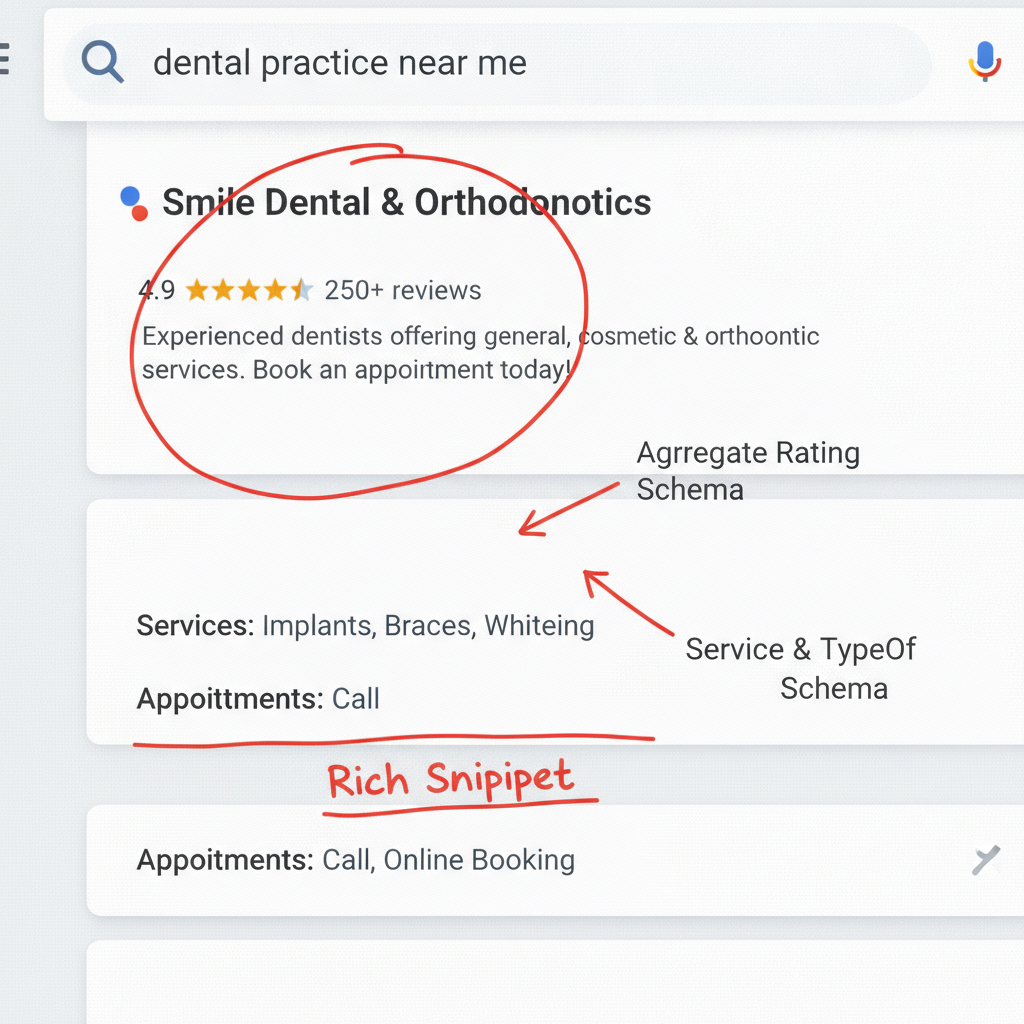
Start with a hands-on technical audit focused on crawlability, page speed, mobile UX, secure connections, and local crawl signals. Fix these items before you scale content — otherwise you waste effort on pages Search engines never index or users abandon.
Step-by-step technical audit (exact checklist you can run in one week)
- Run a site crawl with a crawler (Screaming Frog or equivalent) for 1–2 full passes. Export all 404, 301, canonical, and meta-title/meta-description issues.
- Check robots.txt and sitemap.xml: ensure sitemap is referenced in robots.txt and submitted to Google Search Console.
- Core Web Vitals: measure LCP, CLS, and FID/INP. Use these thresholds as decision gates: LCP <= 2.5s, CLS <= 0.1, FID <= 100ms (or INP similar). If any metric misses the gate, prioritise fixes for images, render-blocking JS, and resource caching.
- Mobile-first: run Lighthouse mobile reports for 90%+ accessibility and a 50+ performance baseline. If mobile nav or forms exceed three taps to submit, redesign the flow.
- HTTPS and mixed content: ensure every page redirects to HTTPS and TLS 1.2+ is enforced. Replace HTTP assets and ensure HSTS is sent on responses.
- Structured data baseline: identify critical pages (home, locations, services, provider bios) for schema injection. See the Schema section for exact JSON-LD types to use.
- Local signals: confirm NAP (Name, Address, Phone) consistency across site footer, location pages, and your Google Business Profile.
- Indexation audit: compare pages indexed in Google vs pages that should be. Prioritise fixing indexation for high-intent service pages.
Fix these technical items first, because they determine whether your content and local signals ever get seen.
Real-world example: a dental practice
A dental office had strong reviews but slow pages and no location pages. We ran a crawl, found duplicate treatment pages, and collapsed them into canonical service pages. That dropped index bloat and improved LCP from 4.3s to 1.9s on top-converting pages. Maps impressions rose and appointment calls increased within 60 days.
How should you structure patient-focused, keyword-rich content?
Build a content matrix that maps Search intent to page types: service pages for appointment intent, blog explainers for informational intent, and provider bios for trust and long-tail queries.
Exact content process with word counts and targets
Follow this numbered process for each treatment or specialty:
- Keyword triage (1 hour): Use local modifiers (city, neighborhood) and filter queries by intent. If a phrase has commercial intent and local Search volume under 200/month, prioritise a service page over a blog post.
- Map to page type: Service page (appointment intent); Pillar article (1,200–1,800 words) for condition + treatment combos; FAQ blocks (5–10 questions) for PAA capture.
- Create the brief: include target primary keyword, three supporting terms, suggested H2s, required CTAs (book online, call, directions), and internal links to related pages.
- Write to conversion: Service pages should include clinic hours, pricing or insurance notes, a clear booking CTA above the fold, and a 300–600 word treatment explainer in the body.
- Publish and measure: Expect to iterate. If CTR < 3% from Search Console for a page ranking in the top 10, rewrite title/meta and test a new CTA in 30 days.
Prioritise pages that match appointment intent and include clear CTAs above the fold.
Real-world example: therapy practice
A therapy clinic published long, generic posts. We shifted to short, specific provider bios and localized condition pages like “CBT for anxiety in [City]” and added clinician availability in each bio. Conversion rates rose because searchers found a named therapist and booked directly through the site.
Content mistakes we see and what to do instead
- Publishing keyword-stuffed thin pages. Do this instead: consolidate thin pages into a single, high-quality page and expand to 800–1,400 words with clinical details Patients actually ask about.
- Relying only on generic blog content for patient acquisition. Do this instead: pair informational articles with internal links to service pages and structured appointment CTAs.
- Ignoring intent signals. Do this instead: classify queries as informational, navigational, or transactional and build pages that answer the immediate intent.
What local SEO strategies actually move the needle?
Optimize Google Business Profile, build precise location pages, collect and reply to reviews, and use local schema. These actions change Maps and local-pack performance.
Google Business Profile: exact checklist and response templates
- Primary and secondary categories: choose the most specific primary category for each location (for example, “General Dentist” not just “Dentist”).
- Business hours and special hours: keep these accurate. If your clinic offers evening hours, list them — users filter by hours.
- Appointment URL: set a booking link that goes to a confirmed landing page with provider availability and a UTM tag for source tracking (example: ?utm_source=GBP&utm_medium=Listings&utm_campaign=ClinicName).
- Services list: add individual services with short descriptions and pricing flags where allowed.
- Photos: upload 8–12 recent, high-quality photos showing office interior, exterior, staff, and technology.
- Review strategy: ask for reviews in person and by follow-up email within 48 hours. Use this template: “Thanks for visiting Dr. X today — if you have two minutes, please share your experience at [link].” Reply publicly to every review within 72 hours with a personalised line and an invitation to call for unresolved issues.
Accurate GBP data and timely review responses directly improve Visibility and click-through rates on Maps.
Location pages and NAP consistency
For multi-location clinics, create a unique location page per clinic. Include schema LocalBusiness for each, a static Google Maps embed, staff lists for that location, and the same NAP format everywhere. If your footer lists multiple clinics, clarify which contact matches which location instead of listing a single address for all.
Local citation trade-offs and what we advise
Chasing hundreds of low-value citations wastes budget. Audit the top 20 local directories and ensure accurate, consistent entries. Higher-value targets include local hospital networks, professional associations, and top local business sites.
How should clinics use schema markup and HTTPS?
Use precise schema types for provider profiles, services, and reviews, and always serve the site over HTTPS. Schema improves the chance of rich results, while HTTPS avoids browser warnings and protects conversions.
Exact JSON-LD types to implement (practical list)
- Organization or LocalBusiness for clinics
- Physician or MedicalBusiness nested under LocalBusiness for provider pages
- MedicalProcedure for specific treatments (surgical procedures, scans, etc.)
- FAQPage for service pages that answer common patient questions
- Review and AggregateRating for testimonials (ensure reviews are real and policy-compliant)
Use JSON-LD embedded in the <head> or at the end of the body for each page type; avoid microdata unless you control all templates.
Security and HTTPS checklist
- Enforce HTTPS with 301 redirects and HSTS header.
- Use TLS 1.2+ and update certificates 30 days before expiration.
- Scan for mixed content after migration and fix insecure scripts and images.
How do you measure patient acquisition from SEO?
Track bookings, calls, and form submissions as conversions in GA4, then add server-side or call-tracking for accuracy. Optimize against real patient actions, not just rankings.
GA4 and conversion tracking exact setup
- Create a GA4 property. Link Search Console and your Google Business Profile insights.
- Define primary conversions: online bookings, phone clicks, contact forms, and direction clicks. Name them clearly (book_online, call_click, contact_form, directions_click).
- Implement gtag or Google Tag Manager and fire events for each conversion. Set event parameters: appointment_type, clinic_location, and campaign_source (UTM source).
- Set up phone call tracking: use call-tracking numbers with dynamic number insertion tied to source/medium. Attribute calls to organic Search when the session source is organic and a call occurs within the same session.
- Use conversion windows and attribution models: use a 30-day conversion window and a data-driven or position-based model for multi-touch paths.
Track the actual patient action, not just rankings; conversions are the signal you optimise toward.
Decision criteria for budgeting SEO vs paid ads
If your clinic needs appointments quickly within 30 days for high-cost procedures, allocate 30–50% of acquisition budget to targeted Search ads while you implement organic fixes. For steady long-term growth, shift spend toward content and local SEO after you stabilise technical and GBP fundamentals.
Comparison: DIY vs Agency for clinic SEO
| Task | DIY | Agency (like Maxseen) |
|---|---|---|
| Technical audits | Requires learning tools and time | Faster, standardized audit and prioritized fixes |
| GBP optimization | Easy to update, but inconsistent | Consistent strategy and review workflows |
| Content creation | Possible, needs clinician time | Scalable, clinically reviewed, and aligned to SEO |
| Reporting | Basic in-house reports | Actionable reports tied to patient acquisition |
How to prioritize fixes — a simple decision matrix
Use this matrix for triage. Rate each task by impact (1–5) and effort (1–5). Prioritise tasks with high impact and low effort first.
- Impact >=4 and Effort <=2: Immediate
- Impact >=4 and Effort >=3: Sprint
- Impact <4 and Effort <=2: Schedule
- Impact <4 and Effort >=3: De-prioritize
Realistic timelines and trade-offs
Expect quick wins in 30–60 days from technical and GBP fixes. Content-driven ranking gains usually appear in 3–6 months for most local queries. Don’t try to fix everything at once; focus resources on high-impact, low-effort items and iterate.
Trade-off to accept: You can publish many pages quickly or publish fewer pages that are deeply optimized and conversion-ready. For clinics, fewer higher-converting pages win.
Frequently Asked Questions
Below are short, conversation-style answers to common questions Patients and clinics ask.
How long until SEO brings new Patients?
Expect measurable improvements from technical fixes and GBP optimization in 30–90 days. Organic ranking and steady patient flow typically build over 3–6 months for most local queries.
Do I need to blog weekly?
No. Quality beats frequency. Publish well-researched, patient-focused pages when they serve intent. A disciplined schedule of one high-value piece per month often outperforms weekly thin posts.
Are reviews necessary?
Yes. Reviews drive trust and local Visibility. Aim for consistent, authentic reviews and respond promptly. Avoid incentivized reviews — that risks penalties.
What’s the one thing clinics ignore that hurts Visibility?
Broken booking flows and inconsistent NAP across directories. Both create friction and lost conversions even if rankings are good.
Next step: get a free SEO audit
If you want a focused plan, schedule a free audit with our team. We’ll run the technical checks above, review your Google Business Profile, and give an action plan you can implement in-house or with our support. Learn about our SEO Services for Healthcare Providers and request your audit.
We work with clinics to turn Search Visibility into actual booked appointments. Start with a one-page prioritized roadmap and measurable KPIs. You’ll know which steps to fund and which to skip.