
Measuring Invisalign Marketing: A Data‑Driven Success Guide


Measuring Invisalign Marketing: A Data‑Driven Success Guide
Invisalign Marketing needs measurable goals, tracked conversions, source-level attribution, and a simple ROI formula so you stop guessing which campaigns actually generate paying patients. This guide gives you specific metrics, thresholds, and a numbered process to turn raw Data into daily decisions for your practice or dental Marketing team.
We wrote this for Invisalign providers who waste ad spend on vanity metrics. You’ll get actionable thresholds, a step-by-step measurement workflow, and exactly what to change when a channel underperforms. We draw on hands-on agency experience — Maxseen runs SEO, SMM, Ads, Email Campaigns, and Qualified Lead Generation Services, so the trade-offs are realistic and practical.
1) Set clear, quantifiable goals before you spend
Start with a single sentence that ties Marketing to business outcomes. For most Invisalign providers that sentence will be: “Generate X booked consultations per month at Y cost per booked consultation (CPBC).”
Make goals numeric, timebound, and tied to revenue: convert monthly target consultations into expected revenue and margin.
Example: a clinic wants 20 booked Invisalign consults per month. If average case value (net to practice after lab and clinical costs) is $2,500 and conversion from consult to paid patient is 35%, then the expected monthly revenue equals 20 × 0.35 × $2,500 = $17,500. That makes it straightforward to compare Marketing cost to expected margin.
Mandatory goal checklist (use this every campaign)
- Primary KPI: Booked consultations per month (not clicks).
- Secondary KPIs: Cost per booked consultation (CPBC), lead-to-paid conversion rate, no-show rate.
- Target thresholds: CPBC <= 20% of expected average case value; lead-to-paid >= 25% (adjust by your practice).
- Time window: evaluate in 30‑, 60‑, and 90‑day windows to account for funnel lag.
If CPBC rises above 20% of case value for 30 days straight, pause or reallocate budget until you diagnose the issue.
Measuring Invisalign Marketing performance
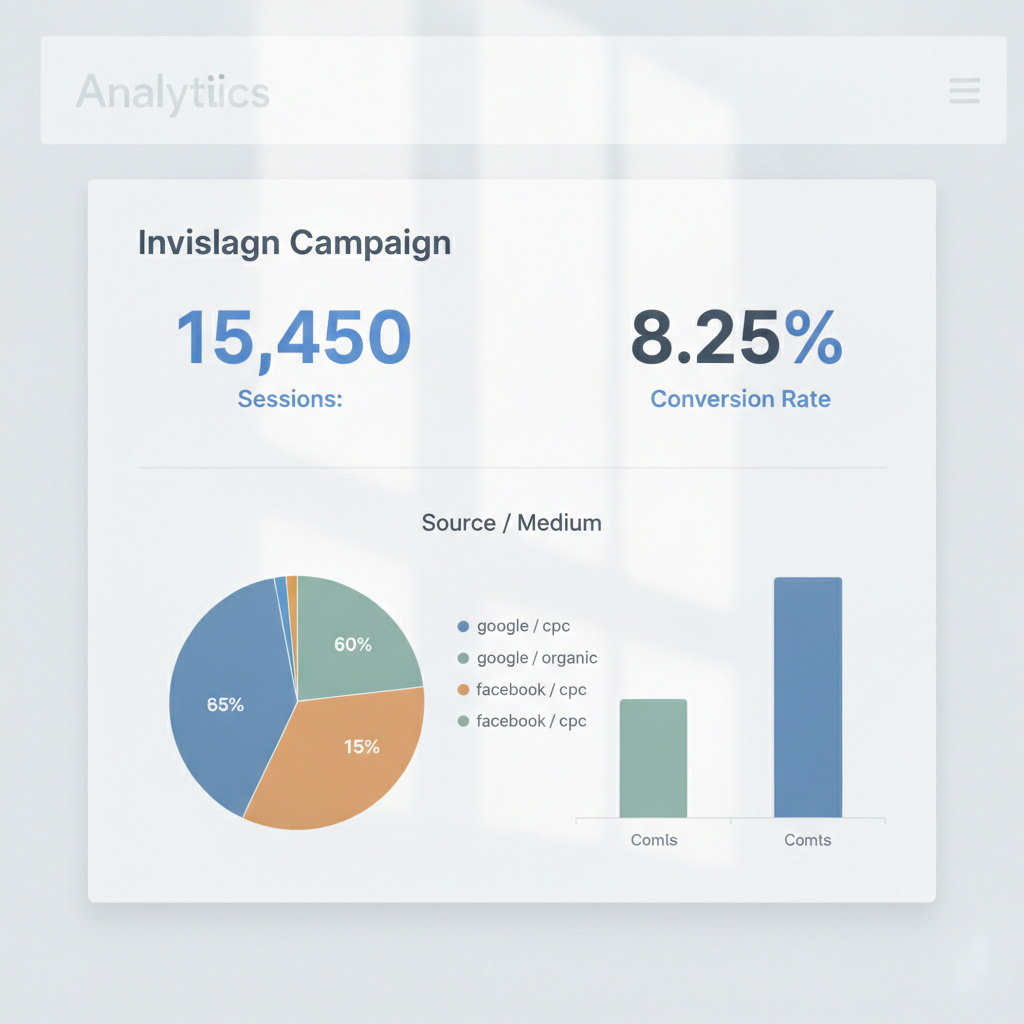
Measurement starts at the conversion, a booked consult, and works backward to channel, campaign, keyword, and landing page. Track every touch so you can name which ad, organic listing, or post produced the consultation.
Map each conversion to source/medium and assign a dollar value equal to expected revenue contribution from that booked consult.
Practical settings we use at the agency level (apply these exactly):
- Google Analytics 4: create a Conversion Event named
booked_consultand mark it as a conversion. Attach a value equal to your expected revenue per consult (e.g., 875 for 35% expected close at $2,500 case value). - Tagging: use UTM parameters on all paid links with utm_source, utm_medium, utm_campaign, and utm_content. For social and email include utm_term for creative names.
- Call tracking: route calls through a dynamic number insertion (DNI) solution and capture the session-level source; forward both the call and the collected UTM Data to your CRM.
- CRM integration: push GA4 event + call tracking Data into the CRM as a single lead record with fields: source, campaign, landing_page, first_touch_date, last_touch_date, and lead_status.
- Lead follow-up: set automated sequences so every booked consult has at least 3 touches (reminder SMS, confirmation email, 24‑hour pre-call call) to reduce no-shows to under 10%.
Once the booking event has a monetary value inside your analytics, channel ROI becomes a simple sum of attributed conversion values versus media spend.
How do I track Invisalign Marketing conversions?
Track bookings as conversions with GA4 events, DNI call tracking, UTM tagging, and CRM records joined on a unique lead ID. Then value each booking and attribute it to the last paid or non-paid touch based on your attribution model.
Implementation detail: add booked_consult in GA4 and use server-side or client-side events to send the booking Data. Make sure your booking widget or phone intake pushes the same lead ID to your CRM. If the booking happens by phone, DNI must capture session UTM values and push them to CRM. If you use third-party booking tools, enable webhooks to export booking events to the CRM in real time.
Decision rule: if a lead has email + phone in CRM but no booking event within 21 days, mark as “cold” and run a re-engagement sequence; if booking exists, mark paid only after service rendered to account for cancellations.
Track website analytics: traffic, conversions, and source/medium
Traffic alone lies. You’re tracking visitors; you should optimize for visitors who convert to booked consults and then to paid patients. Configure analytics to expose funnel drop-off at page level and channel level.
Set these dashboard widgets immediately: Booked consults by source/medium, landing page conversion rate, assist conversions by page, and cost-per-booked-consult by campaign.
Concrete GA4 settings and thresholds (copy-paste)
- Event:
booked_consult(marked as conversion) - Parameter:
consult_value(numeric, set to expected revenue per consult) - Audience: “Booked in last 90 days” (users with booked_consult within last 90 days)
- Segments: Paid Search, Paid Social, Organic, Referral, Direct
Thresholds we monitor weekly:
- Landing page conversion rate: aim for >= 3% on campaign landing pages.
- Bounce rate on booking pages: aim for <= 40% (desktop); <= 55% (mobile).
- Average time on booking page: > 90 seconds (indicates engagement).
If landing page conversion drops >30% versus baseline for two weeks, run a content and UX review before raising bids.
Comparison: paid search vs. organic lead profiles
| Metric | Paid Search | Organic / SEO |
|---|---|---|
| Avg CPBC | Typically higher but faster scale | Lower CPBC over time; slower to scale |
| Lead intent | High intent (commercial keywords) | Mixed intent; strong local SEO converts well |
| Best role | Fast testing and promos | Long-term, consistent lead flow |
Monitor social media engagement and lead flow
Social platforms drive awareness and reviews, but measure the actions that tie to bookings: link clicks to booking page, story swipe-ups that result in bookings, and messaging funnels. Track these as assisted conversions in GA4 and your CRM.
Prioritize click-through rate (CTR) to booking pages and direct messages that convert to consults over likes and impressions.
Practical metrics and thresholds for social:
- Post CTR to booking landing page: aim >= 1.5% for organic posts, >= 2.5% for paid creative.
- DM-to-booking conversion: track messages that enter the CRM; target >= 8% to booked consult.
- Ad creative testing: swap one element at a time (headline, image, CTA). Keep winners with >15% relative uplift in CTR and >10% uplift in booked consults over baseline.
Common mistake: optimizing solely for engagement metrics like saves and shares without Measuring direct booking impact. Those metrics help brand, but you must map impressions to consultations to justify spend.
What counts as a qualified lead for Invisalign Marketing?
A qualified lead meets clinical and financial criteria and takes a high-intent action (booked consult or phone screening). Make qualification explicit in CRM fields.
Define qualification fields in CRM:
- Clinical fit: age range, orthodontic issue, prior treatment history (yes/no).
- Financial readiness: willingness to finance or pay deposit (yes/no).
- Intent: booked consult scheduled within 30 days or phone-screened with follow-up scheduled.
Qualification rule: only mark “Qualified” if (clinical_fit = yes) AND (financial_ready = yes OR booked_consult_date within 30 days).
Why this matters: ad platforms optimize for the signals you feed them. If you pass a raw “lead” event that includes many unqualified inquiries, the algorithm learns the wrong audience. Instead, pass back a post-conversion signal (CRM lead_status = Qualified) so platforms can optimize for real paying patients.
Evaluate qualified lead generation and ROI for dental practices
Evaluate ROI at two levels: Marketing ROI and practice economics. Marketing ROI = (Attributed Revenue − Ad Spend) / Ad Spend. Practice economics fold in overhead, clinical capacity, and staff time.
Use this simple ROI formula and decision thresholds to act: if Marketing ROI < 0.5 for 45 days, reduce spend or change channel.
Step-by-step ROI calculation (copyable):
- Calculate attributed revenue: sum of consult_value for all conversions attributed to channel in your attribution window (we use 30 days last-click for paid search, 90 days for organic assists).
- Subtract direct ad spend for that channel during same window = Gross profit contribution.
- Divide by ad spend to get Marketing ROI. Example: $25,000 attributed revenue − $7,000 ad spend = $18,000. ROI = $18,000 / $7,000 = 2.57 (257%).
- Adjust for clinical conversion rate and overhead: multiply attributed revenue by clinic close rate to get expected net revenue.
Decision criteria we use at Maxseen:
- CPBC target: <= 20% of average case value.
- Marketing ROI target: >= 1.0 (break-even) to continue scaling; >= 2.0 to scale aggressively.
- Channel pause rule: if CPBC increases by 30% and ROI falls below 1.0 for two consecutive 30-day windows, pause that campaign and shift 50% of budget to top two performers.
Turn insights into actionable strategy tweaks

Data without fast action wastes budget. Below is a repeatable weekly and monthly workflow to turn analytics into improvements.
Implement a 7-step weekly check and monthly optimization loop to keep campaigns profitable.
- Weekly: review booked consults by source; flag channels with CPBC > target.
- Weekly: check landing page metrics; if conversion rate drops >30% vs baseline, run an A/B test on CTA or form length.
- Biweekly: refresh top-performing ad creative or switch off low performers (use 14-day test window, 95% confidence via conversion lift tests if volume allows).
- Monthly: calculate Marketing ROI by channel and apply the channel pause rule above.
- Monthly: update audience signals in platforms by uploading “qualified” lead hashes to re-train lookalikes.
- Quarterly: review clinic capacity and adjust target consult volume to avoid backlog or under-utilization.
- Quarterly: refresh SEO content with intent-based pages targeting local transactional queries for Invisalign near-me and practitioner + Invisalign terms.
Example trade-offs we face as an agency: paid search scales fast but costs more per booking; organic SEO converts cheaper but takes months. We advise most practices to run a blended funnel: short-term paid search for immediate bookings and local SEO for lower-cost bookings in months 3–12.
Testing plan: A/B testing matrix you can copy
Test one variable at a time. Use this table as your A/B matrix for landing pages and ads.
| Test | Variant A | Variant B | Success metric |
|---|---|---|---|
| CTA copy | “Book a free consult” | “Reserve your Invisalign consult” | Landing page conversion rate |
| Hero image | Before/after patient | Provider smiling in clinic | CTR to booking page |
Reporting: what to include in weekly and monthly dashboards
Keep weekly dashboards short and focused. Monthly reports must tie to revenue and patient outcomes so practice owners can see the business impact.
Weekly dashboard essentials: booked consults, CPBC per channel, landing page conversion trends, and top 3 creatives by CTR.
Monthly adds: Marketing ROI by channel, qualified lead-to-paid conversion, average time from first touch to booking, and a notes section for tactical changes made that month. Use this to correlate actions with performance.
Compliance and clinical context
Advertising Invisalign involves medical-device considerations. Use factual descriptions and avoid unverified medical claims. If you need regulatory background on Invisalign specifically, reference the FDA Invisalign Overview for official details on the device and regulatory statements.
Keep patient testimonials accurate and current, and retain signed consent for any before/after creative used in ads or on your site.
Common mistakes and what to do instead
- Mistake: Optimizing for clicks and impressions. Do this instead: optimize for booked consults and completed cases.
- Mistake: Not passing offline conversions back to platforms. Do this instead: upload qualified lead conversions or use server-side conversion APIs.
- Wrong attribution: attributing revenue only to last-click. Do this instead: use last-click for short-term decisions but review multi-touch assisted conversions monthly.
- Over-optimizing creative without checking landing page flow. Do this instead: test landing page changes with the same rigor as ad creative.
Fix these errors and you’ll stop paying for attention and start paying for patients.
Frequently Asked Questions
How long before I see results from Invisalign Marketing?
Expect paid search results within days; expect local SEO and content Efforts to show meaningful volume in 3–6 months. Use a blended approach for immediate bookings and longer-term, lower-cost leads.
What’s a realistic cost-per-booked-consult (CPBC)?
CPBC varies. As a planning rule, aim for CPBC no greater than 20% of your average case value. Adjust this threshold for your clinic’s margin and local competition.
How do I prove the value of my campaigns to practice owners?
Show booked consults tied to revenue using attributed consult values in your reporting, present Marketing ROI by channel, and compare cost-per-paid patient month over month.
Do you recommend using third-party booking tools or the clinic’s phone line?
Use both. Booking widgets reduce friction for online users; a staffed phone line captures older, high-intent patients. Make sure both feed the same CRM and tracking IDs.
Can Maxseen help implement this measurement stack?
Yes — our team builds the tracking, runs campaigns, and hands you dashboards that focus on booked consults and ROI. Learn more about Our Full‑Service Digital Marketing Solutions.
Next steps — schedule a free strategy call
If your Invisalign Marketing still feels like guesswork, let’s fix that. We’ll review your current tracking, set up conversion events, and map a 90‑day plan to reduce CPBC and increase booked consults. Book a free strategy call with Maxseen to get a custom measurement checklist and an initial campaign health audit.
Book a free strategy call and stop spending on vanity metrics — focus on bookings and revenue instead.