
Why SEO for Professional services Is Your Marketing Foundation


Why SEO for Professional services Is Your Marketing Foundation
Quick Answer: SEO for Professional services turns search intent into predictable client acquisition by aligning content, technical site quality, and local visibility with buyer behavior. Within 90 days you can establish tracking, prioritize transactional keywords, and launch pages that feed paid and social channels for steady, measurable lead flow.
Why SEO for Professional services is the foundation of your Digital Marketing Strategy
Competition for clients is tight. When Firms ignore search they leave recurring revenue on the table and make acquisition expensive and inconsistent. Organic search brings prospective clients who are actively looking for a Service, not scrolling past your message.
SEO builds a discoverable pipeline that lowers cost per client and stabilizes growth. Stop overpaying for one-off clicks and start Winning visibility that converts for months or years. That predictability lets you plan hiring, intake capacity, and pricing instead of chasing ad budgets every quarter.
How does SEO support paid search, social, content, and web design?
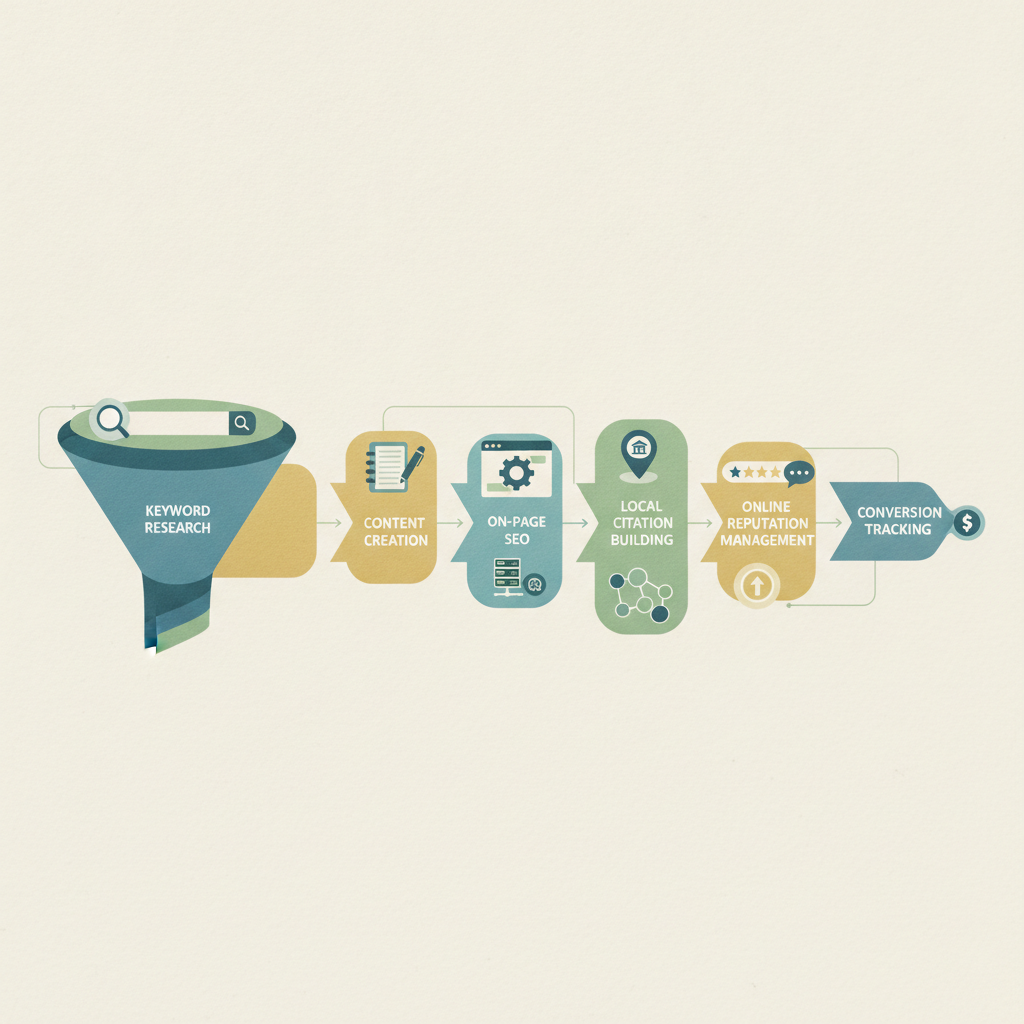
SEO is the organizing layer that makes every other channel more efficient.
Organic keyword data tells you what real prospects search for, which then informs paid keyword choices and social audiences. When landing pages answer high-intent queries, your ad spend converts at a higher rate. A blog post that ranks also supplies shareable copy and authority signals that improve email nurture sequences.
Treat SEO as the roadmap: the keywords and pages you optimize should steer ad copy, social topics, and conversion paths.
What specific editorial stance do we recommend?
Prioritize transactional and local intent over vanity traffic. High-volume informational keywords look good on a report but they rarely produce clients for Service businesses that need bookings now.
Transactional phrases like “hire divorce lawyer [city]” or “best therapist near me” convert far better than broad how-to queries. For most Firms, ranking for a focused set of high-intent phrases yields faster, measurable intake.
Pick fewer, high-intent targets and own them regionally rather than chasing nationwide volume.
Three short case snapshots: what a focused SEO approach looks like
These snapshots show the KPIs we track and the concrete tactics we deploy to turn searchers into clients.
Each snapshot lists the scenario, primary KPIs, the tactics we applied, and how we measured outcomes. These are anonymized operational examples, not Marketing copy.
Law firm snapshot — intake-driven keyword focus
Scenario and goal: A mid-sized law firm needed predictable civil litigation intake. We prioritized local transactional keywords and improved intake UX.
- Primary KPIs: organic phone calls (call-tracking), contact form submissions, ranking for 8 prioritized transactional keywords.
- Tactics: location-specific landing pages, schema for legal Service and LocalBusiness, targeted content answering fee structure and process, and call-tracking integration.
- Measurement approach: use UTM + call recording to attribute first-touch, and measure conversion rate of organic sessions to leads over rolling 30-day windows.
Result: organic became a visible, measurable intake channel instead of a passive referral source.
Therapy practice snapshot — trust and conversion optimization
Scenario and goal: An individual therapy practice wanted steady new client bookings without outspending competitors on ads.
- Primary KPIs: booked consultations, website-assisted appointment starts, patient-oriented long-tail keyword rankings.
- Tactics: therapist profile pages with vetted bios, content addressing common therapy questions, microcopy that reduces friction on appointment pages, local citations and Google Business Profile optimization.
- Measurement approach: track appointment completions using calendar integrations and attribute by source/medium; monitor long-tail ranking movement weekly.
Result: search turned into a steady source of consultation requests because the site converted visits into scheduled calls.
Dental clinic snapshot — local SEO with conversion focus
Scenario and goal: A dental practice wanted improved visibility for urgent and cosmetic procedures within a 10-mile radius.
- Primary KPIs: Google Business Profile calls, driving direction requests, appointment bookings for targeted services.
- Tactics: Service-specific landing pages with Service area modifiers (e.g., “root canal [neighborhood]”), review solicitation workflow, and structured data for medical/dentistry services.
- Measurement approach: weekly GBP insights review, local rank tracking for Service-area combinations, and appointment-attribution via booked-Service tags.
Result: more appointments came from search-driven discovery rather than directory listings or referrals alone.
What is the exact 90-day, numbered process we implement for Service Firms?
Answer: We run a 7-step, 90-day sprint designed to create measurable traction and feed longer-term growth.
- Discovery & Tracking (Days 1–7)
- Install server-side Google Tag Manager and configure GA4 with cross-domain if needed.
- Enable phone call tracking and link it to GA4 as events (use gtag event name: ‘phone_lead’).
- Set initial KPI baselines: organic sessions, goal completions, phone calls, MQLs. Record 30-day baseline.
- Keyword Prioritization (Days 8–14)
- Build a 60-keyword list segmented by intent: transactional (weight 50%), local (30%), informational with conversion potential (20%).
- Decision rule: prioritize keywords with local relevance and minimum estimated monthly demand of 30 searches, or clear local intent (“near me”, city modifier).
- Technical Fixes (Days 15–30)
- Targets: LCP <= 2.5s, CLS <= 0.1, INP <= 200ms. Use PageSpeed insights and Lighthouse to measure.
- Deploy: compress images, enable critical CSS, reduce third-party scripts below 5 initial requests when possible, implement server-side caching and a CDN.
- Local & On-Page Optimization (Days 31–45)
- Optimize Google Business Profile, ensure NAP consistency across 10 priority local citations, add Service-area landing pages.
- On-page checklist per landing page: unique title (include term + city), meta description with CTA, H1 with intent phrase, schema for Service/LocalBusiness, 400–1200 words answering intent.
- Content & Authority Build (Days 46–75)
- Publish 6 priority landing pages targeting transactional terms and 8 supporting posts aimed at long-tail informational queries tied to conversion.
- Internal linking rule: every Service page must be linked from the homepage and from at least two blog posts within 30 days of publishing.
- Conversion Optimization (Days 76–85)
- Run A/B tests on primary landing pages: headline, CTA copy, and lead capture flow. Minimum sample size rule: run until statistical significance of 95% or 2 weeks, whichever comes first.
- Implement micro-conversion tracking: brochure downloads, appointment starts, chat interactions.
- Review & Handoff with 90-Day Guarantee (Days 86–90)
- Deliver an outcomes report showing baseline vs current KPI trend and a 90-day plan for scaling. This is where we activate the Maxseen 90-day results guarantee.
- Decision criteria for next phase: if targeted transactional keywords have moved into top-10 and organic leads increased over baseline, scale content and link acquisition; otherwise, iterate on conversion and technical fixes.
This sequence is tactical and measurable—each step produces testable outcomes we can report on at day 90.
How do we measure success and make decisions?
Use connected data: GA4 sessions, goal conversions, call-tracking events, and Google Business Insights. Those let you make go/no-go decisions with confidence.
Rankings are a signal, not the final metric. Lead volume and conversion rate are what pay your bills. Define success by lead volume and quality versus baseline, not by impressions alone.
Measure leads, attribute them, and act on conversion-rate improvements rather than raw traffic.
How long until SEO produces reliable leads?

You can expect measurable traction in 60–90 days from the sprint above, with stronger stability between 6–12 months depending on competition and budget.
Combine targeted paid search with the SEO sprint if you need guaranteed higher lead volume faster.
Comparison: SEO vs PPC vs Social for Professional services
Each channel has a role: paid for immediate demand, SEO for durable discovery, social for awareness and retargeting.
| Channel | Time to impact | Cost behavior | Best for |
|---|---|---|---|
| SEO | 60–180 days | Upfront investment, lower marginal cost per lead over time | High-intent discovery, local services, sustainable leads |
| PPC (Search) | Immediate | Pay per click; cost scales with volume | Immediate demand capture, competitive markets, controlled testing |
| Social | Days–weeks (brand) or immediate (ads) | Variable; ads are paid, organic reach is limited | Awareness, retargeting, culture fit and reputation building |
What common mistakes do Firms make and what to do instead?
Firms often mistake traffic for leads, ignore intent, and silo channels so they don’t share what works. Those three errors make Marketing expensive and slow.
Fix one: stop chasing high-volume informational keywords that don’t convert. Fix two: track calls and booking sources with call-tracking tied into analytics. Fix three: treat SEO as continuous work, not a one-off project.
Optimize for lead quality and predictable intake, not for impressions.
How Maxseen integrates SEO into a full-funnel Strategy
We pair SEO with paid, social, and email so the traffic SEO generates converts across channels.
Start with SEO to identify high-intent keywords, then use those queries to shape paid search campaigns and social copy. Content that ranks becomes email sequences that nurture prospects into sales-ready conversations.
Let SEO direct the playbook for paid, social, and email campaigns to reduce wasted spend and shorten sales cycles.
Learn more about our approach on the SEO Services Overview and how we combine organic with paid in our Qualified Lead Generation for Service Businesses playbook.
For the business case and research on why SEO is central to efficient Marketing Strategy, see Why SEO Is Critical to Digital Marketing (Harvard Business Review) and the technical and tactical primer in the SEO Guide (Search Engine Journal).
Pricing and ROI expectations for Service Firms
Expect an initial investment for technical fixes, content creation, and local optimization. ROI depends on average client value and conversion-rate improvements.
Calculate break-even by dividing initial SEO spend by the additional monthly gross revenue from organic leads. If your average client value is $5,000 and organic leads produce two extra clients per month, you’ll validate the spend quickly.
We show you the payback math during discovery so the 90-day sprint is judged on revenue impact, not rank alone.
Frequently Asked Questions
Below are concise answers to the questions we hear most.
How much do Professional Service Firms spend on SEO?
Spending varies: small practices May spend a few thousand per month while larger Firms invest more. We model the right spend during discovery so it produces positive ROI within your planning horizon.
Can SEO replace paid advertising?
No. SEO reduces long-term cost per lead but paid search buys predictable immediate demand. Use both: paid for short-term volume, SEO for durable and compounding visibility.
How do you track phone leads and attribute them to SEO?
We install call-tracking with dynamic number insertion and push call events into GA4 as ‘phone_lead’ events. Then we use UTM parameters and CRM tags to keep attribution consistent across the funnel.
What does Maxseen’s 90-day results guarantee mean?
Our 90-day results guarantee sets specific sprint milestones. If we hit technical and content milestones and you provide approvals and local access, we report measurable improvements in targeted visibility and lead tracking by day 90 or follow the remediation path outlined in the guarantee.
How do I get started?
Schedule a Strategy call to align on goals, baseline metrics, and timelines. We’ll deliver a prioritized 90-day plan tailored to your Service vertical and local market conditions.